
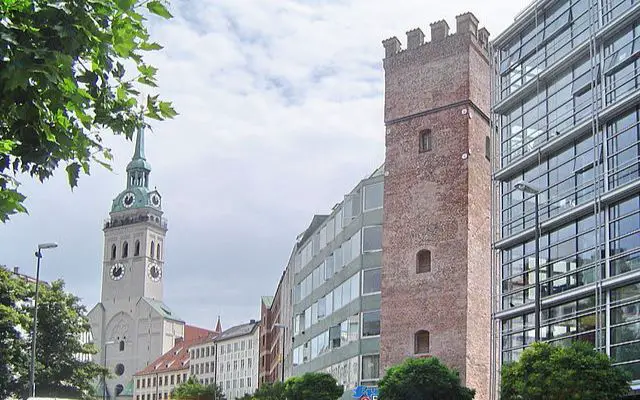
Rindermarkt is the small Old Town square immediately south of Marienplatz, named after Munich’s former cattle market. Look for the terraced cattle fountain and the brick Löwenturm among the surrounding buildings. The square is free to visit and works well as a short pause between St Peter’s Church and the Viktualienmarkt.
Updated
Quick Facts
| Quick fact | Details |
|---|---|
| Location | South of Marienplatz, beside St Peter’s Church |
| Admission | Free outdoor square |
| Main sights | Rindermarktbrunnen, Löwenturm and Ruffinihaus |
| Fountain | Josef Henselmann’s cattle fountain, 1964 |
| Nearest station | Marienplatz, U3/U6 and central S-Bahn services |
| Allow | 15–30 minutes, longer with nearby Old Town sights. |
| Christmas | Part of the city Christkindlmarkt area. Check seasonal dates. |

Why is the square called Rindermarkt?
Rinder means cattle and Markt means market. The name records the livestock trading which once took place here, on the streets leading south from Munich’s central square. Farmers brought animals into the city, and the market served a much less built-up Munich.
The cattle market continued into the 19th century. Modern livestock trading moved away from this central setting, leaving the name, street pattern and later memorial fountain to carry the history.
Today the square serves shops, pedestrians and people stopping for a drink or lunch. The scale is smaller and less ceremonial than Marienplatz. Walk a short distance from the main square and the traffic of people changes from sightseeing crowds to a mixture of shoppers and locals crossing the Old Town.
The cattle fountain
Josef Henselmann’s Rindermarktbrunnen dates from 1964. The terraced stone fountain includes three cattle, with their herder set apart from the animals. The figures make the former purpose of the square understandable without a long history lesson.
Look from more than one side, since the levels and arrangement change as you move around. When the water is running, the fountain gives the square a pleasant sound and a focus for people sitting nearby.
The design is modern rather than a surviving medieval cattle trough. The name and subject preserve the connection with livestock, while the fountain belongs to the post-war shaping of the square.
The Löwenturm
The narrow brick tower stands among much newer façades. At around 23 metres high, the Löwenturm looks like a fragment from another period left within the modern city.
Its name means Lion’s Tower. Earlier accounts linked the structure to Henry the Lion and Munich’s first fortifications, but the city’s history guide explains the tower was not part of the city wall. Its precise early purpose has been debated, with a connection to the old watercourses among the explanations.
The tower has no ordinary visitor entrance or staircase. Treat the visit as an exterior look. The contrast between the brickwork, battlements and surrounding buildings is the part you get to examine from the square.
The Ruffinihaus
Take time for the ornate Ruffinihaus ensemble on the edge of the square. Gabriel von Seidl designed the buildings in the early 20th century, with varied façades and decorative details which reward looking above the shops.
The ensemble belongs to a different period from the tower and the cattle market. Together they show why the square is more useful as a walk through layers of Munich history than as a single preserved medieval scene.
Christmas at Rindermarkt
During the main Christkindlmarkt, stalls extend from the Marienplatz area into Rindermarkt. The Sternenplatzl gives this part of the market its own setting. The tighter space and lights create a different atmosphere from the large square beside the New Town Hall.
Dates and daily opening arrangements change by year. Use the official city Christmas-market page and our Munich Christmas markets guide for your dates.
Outside the festive season, the fountain and surrounding streets make the square worth including in an Old Town walk. Winter stalls are an extra reason to stop, rather than the only purpose of the visit.
Nearby places to add
St Peter’s Church stands close to the northern end. The church and its separate tower climb offer a different view of the centre. From above, the relation between Marienplatz, Rindermarkt and the Viktualienmarkt becomes clearer.
The Viktualienmarkt is a short walk east. Food stalls and shops make the market a practical place to find lunch. Returning to the square with food gives you a quieter pause when seats and local conditions permit.
The Münchner Stadtmuseum is also nearby, but its main museum is closed for major renovation until a planned reopening in 2031. Check its current programme for interim activities rather than expecting the full local-history galleries.
For another nearby indoor visit, the Jewish Museum stands on St.-Jakobs-Platz. The buildings and memorials around the square add further history within a short walk.
Getting to Rindermarkt
Marienplatz is the simplest station for most visitors. U3, U6 and S-Bahn services on the central route stop there. Walk south from the square towards St Peter’s and Rindermarkt.
The Old Town’s pedestrian streets make walking more straightforward than trying to arrange a car drop-off beside the fountain. Paid parking exists in the wider centre, but a central address is not a promise of convenient spaces or road access.
Check MVG for the best current connection from your starting point. Older lists of nearby bus and tram routes are less reliable than choosing a journey to Marienplatz and finishing on foot.
Is Rindermarkt still a cattle market?
No. The name and the fountain recall its former use. The square now serves shops, pedestrians and seasonal events.
Is the Löwenturm open to climb?
No public climb is offered. View the tower from the square, then continue to St Peter’s if you want a separate Old Town tower viewpoint.