
Start with the Glockenspiel and Frauenkirche for Munich’s best-known Old Town landmarks. Add the Residenz lions, royal statues and Hofgarten around Odeonsplatz. Farther out, the Bavaria statue, Olympic Tower and modern sculptures reveal different sides of the city. Our selection covers 21 monuments plus the Dianatempel, with the details that make each worth a closer look.
Updated
Quick Facts
| Planning question | Useful answer |
|---|---|
| Best first cluster | Marienplatz, Frauenkirche, Residenzstraße, Max-Joseph-Platz and Odeonsplatz. |
| Mostly free? | Exterior views are generally free. Tower climbs and museums have separate admission and opening times. |
| Winter closures | Bavaria statue interior and Ruhmeshalle closed through 19 March 2027. |
| Major works | Olympic Tower closed, expected reopening from October 2027. Feldherrnhalle scaffolded, restoration expected until 2028. |
| Glockenspiel | 11 am and noon daily, plus 5 pm from March to October. No show on Good Friday. |
| Time needed | Choose a few nearby stops for half a day. The complete list spans several neighbourhoods and needs more than one walking route. |
Which landmarks are close together?
Our list is a selection of monuments and sculptures rather than a ranking. We would choose one area and enjoy the details instead of trying to collect all 22 in a day. The numbered list lets you find individual sights, while these groups help with the actual journey.
- Old Town: Karlstor, Frauenkirche and Glockenspiel fit a walk through the pedestrian centre. Isartor and Sendlinger Tor extend it to the eastern and southern edges.
- Palace quarter: Max Joseph, the Residenz lions, Feldherrnhalle, Ludwig I and Dianatempel sit close together. Promenadeplatz and its Michael Jackson memorial make a short detour.
- Ludwigstraße and Schwabing: walk north from Odeonsplatz to the Siegestor and Walking Man, then turn towards the English Garden and Chinese Tower.
- Separate outings: pair Bavaria and the Ruhmeshalle with Bavariapark; visit the Endless Staircase in Schwanthalerhöhe; put Hubertusbrunnen on a Nymphenburg Canal walk. The Angel of Peace and Olympiapark need their own place in the day.
1. Endless Staircase

The Endless Staircase, also known as Umschreibung, is a piece of public art in the Schwanthalerhöhe district. Danish-Icelandic artist Olafur Eliasson created it in 2004. Its intertwined flights turn back on themselves, suggesting a journey with no final destination.
The setting is part of the surprise. Rather than standing on a grand square, the sculpture occupies the courtyard of an office complex on Ganghoferstraße. From outside, it is easy to pass the building without realising what lies behind it. Look for the courtyard access and respect the working property around the artwork.
Eliasson often explores how people experience space, movement and their own position. Here, the familiar staircase becomes something you can follow with your eyes without arriving anywhere. Walking around the base changes how the loops overlap, so give it more than a single head-on photograph.
Treat this as a viewing stop. The property owner has announced plans to restore the walkable sculpture, but there is no confirmed public climbing timetable. A roughly 40-minute walk from the centre is possible, or use public transport to the Schwanthalerhöhe area. Our Endless Staircase guide explains the location and artwork in more detail.
2. Walking Man

Jonathan Borofsky’s Walking Man strides beside Leopoldstraße in Schwabing, outside Munich Re’s premises. Unveiled in 1995, the white figure rises 17 metres above the pavement. Its enormous scale makes an ordinary human action visible from well along the street.
The sculpture feels at home in this part of Munich, where the broad avenue carries on north from the Siegestor into Schwabing. Its simple outline and forward movement contrast with the military and royal imagery of the older monuments farther south. Look from both sides of the street to see how the changing angle alters its balance.
There is no exhibition ticket or interior visit attached to the street view. Combine it with the Siegestor and a walk through Schwabing, or approach from the western edge of the English Garden. Nymphenburg Palace is across the city and needs a separate journey.
Allow about 15 minutes for the sculpture itself, longer if you enjoy street photography. The Walking Man article covers Borofsky’s construction, the commission and the figure’s place in the neighbourhood.
3. Lady Bavaria Statue

Lady Bavaria stands above the western edge of Theresienwiese, with the Ruhmeshalle behind her. The bronze figure is 18.52 metres high before the pedestal is counted. Approaching across the huge festival ground makes the scale clearer than a distant skyline photograph.
King Ludwig I commissioned the monument, Ludwig Schwanthaler developed the figure, and Ferdinand von Miller’s foundry work brought the enormous casting to completion. Unveiled in 1850, it was a major achievement in 19th-century bronze casting. Bavaria personifies the region, accompanied by a lion and holding an oak-leaf wreath.
The unexpected attraction is the small viewing space inside the head. In the open season, you reach it by a narrow stairway: the city lists 48 outdoor steps and 126 inside. This is an enclosed, stair-only climb with small openings, so choose it according to your comfort with tight spaces.
The statue interior and Ruhmeshalle are closed for winter through 19 March 2027. You can still see the group from the public fairground side, subject to event boundaries. The Bavaria statue guide explains seasonal admission and the climb.
4. Siegestor

The Siegestor, or Victory Gate, marks the junction of Ludwigstraße and Leopoldstraße beside the university. Its three arches form the northern conclusion to the long avenue from Odeonsplatz. Friedrich von Gärtner designed it for Ludwig I, taking the Arch of Constantine in Rome as his model.
Above the arch, Bavaria rides a chariot drawn by four lions. The lions are an easy detail to miss if you assume every classical quadriga has horses. Battle reliefs and the northern dedication to the Bavarian army explain the gate’s original purpose.
The Second World War changed both the building and its message. The reconstructed southern side bears an inscription dedicating it to victory, acknowledging destruction by war and urging peace. Walk around both sides: the contrast is more revealing than treating the gate as a decorative entrance.
Universität, on U3 and U6, is the usual nearby station. Use the marked crossings around the busy junction. The gate is also an effective starting point for a southbound walk along Ludwigstraße to the Old Town. Our Siegestor guide looks more closely at the inscriptions and restoration.
5. Friedensengel

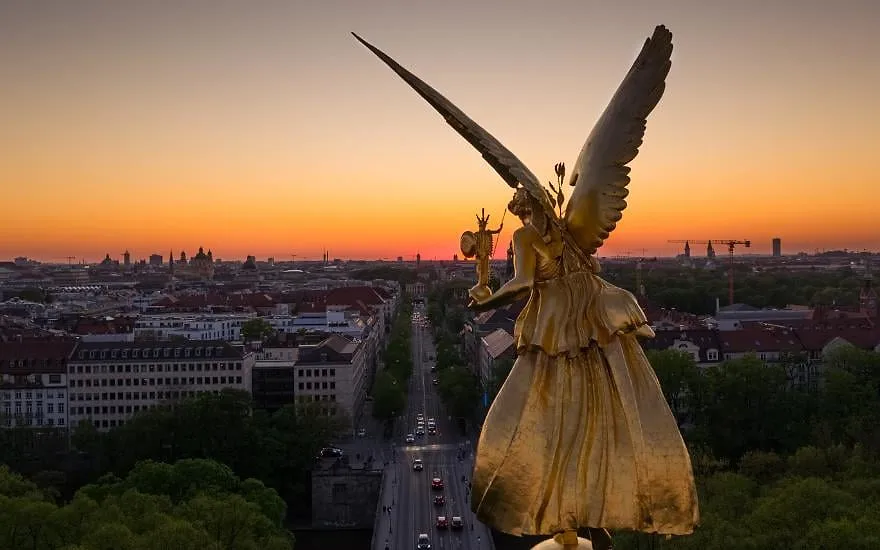
The Friedensengel, or Angel of Peace, rises above the eastern bank of the Isar at Europaplatz. From below, the golden figure seems to float above the trees. From the terrace, you look west across the bridge and along Prinzregentenstraße.
Built between 1896 and 1899, the monument marked 25 years of peace after the Franco-Prussian War. The complete structure is about 38 metres high. Its six-metre gilded bronze figure takes its model from Nike, the ancient Greek goddess of victory, and carries an olive branch and a small Athena figure.
Look into the temple-like base for the mosaics of war, victory, peace and culture. The lower fountain, stairs and terraces belong to the overall composition. They also explain why photographs taken from river level look so different from those taken beside the column.
The public viewpoint is the terrace at the base; there is no visitor climb up the column. Outdoor stairs and sloping park paths connect the levels. Combine it with a stroll through the Maximiliansanlagen, allowing extra time if you want the lower fountain as well. See our Angel of Peace guide for the monument’s history and approaches.
6. Isartor

Isartor is the eastern gateway to the Old Town at the end of Tal. Built in 1337, it is one of Munich’s three surviving major medieval gates and the one that retains the central main-tower arrangement. The high tower and two flanking towers make its former defensive purpose easy to recognise.
The fresco across the gate depicts Ludwig the Bavarian’s triumphal procession after the Battle of Mühldorf. It belongs to the 19th-century restoration, so the image of the Middle Ages was itself painted centuries later. Compare the clocks, too: the side facing the Old Town has a mirrored dial and runs backwards.
The museum in the towers celebrates Karl Valentin and Liesl Karlstadt, rather than providing a general history of Munich’s defences. The Valentin-Karlstadt-Musäum reopened in July 2026 after renovation. Its exhibition and café involve spiral stairs and have a separate admission charge.
Walking through the gate fits a short Old Town visit. The nearby Isartor S-Bahn station is useful if you want to begin here and continue along Tal to Marienplatz. Read our Isartor guide for current museum arrangements and the details to look for outside.
7. Ruhmeshalle

The Ruhmeshalle, or Hall of Fame, is the pale limestone colonnade behind Lady Bavaria. Leo von Klenze designed it for Ludwig I, with construction running from 1843 to 1853. The Doric columns and three-winged plan reflect the king’s interest in ancient Greek architecture.
Busts inside honour people associated with Bavaria’s arts, science and public life. The collection makes the monument a succession of individual biographies, rather than simply a backdrop for the larger statue. Read the names as well as looking at the faces, especially those unfamiliar to you.
The long colonnade rewards a sideways view. From across Theresienwiese it frames Bavaria; closer up, the repeated columns and portraits become the main attraction. Wartime damage and later reconstruction form another part of its history, and the collection has continued to grow beyond Ludwig’s original selection.
The hall shares the winter closure through 19 March 2027. For greenery after an exterior visit, Bavariapark lies nearby, with lawns, trees and paths. The Ruhmeshalle article explains the collection and seasonal access.
8. Michael Jackson Memorial

Munich’s Michael Jackson memorial is a fan-created tribute on Promenadeplatz opposite the Hotel Bayerischer Hof, where he stayed during visits to the city. Since 2009, fans have left flowers, photographs, candles and messages around the base of an older monument.
The statue above those tributes represents Orlando di Lasso, the 16th-century composer who worked at the Bavarian court. It is worth separating the two identities: the bronze figure honours the composer, while the changing display below remembers Michael Jackson.
That combination gives the memorial its unusual character. A formal monument and a personal expression of mourning occupy the same place, with the hotel explaining why fans chose this particular square. The offerings change, so a photograph records a moment in the memorial’s continuing life.
It is a short outdoor stop within walking distance of Frauenplatz and the northern Old Town. Leave space for people paying their respects and avoid moving the tributes for a picture. Our Michael Jackson memorial guide explains the connection with Munich and the history of the site.
9. Feldherrnhalle

The Feldherrnhalle stands at the southern end of Odeonsplatz between Theatinerstraße and Residenzstraße. Ludwig I commissioned the open loggia from Friedrich von Gärtner, who built it between 1841 and 1844 using Florence’s Loggia dei Lanzi as an architectural model.
Its two commanders are Johann Tserclaes, Count of Tilly, and Carl Philipp von Wrede. The lions beside the steps and the later central military monument add further layers to the original tribute to the Bavarian army. They are best understood as parts of a 19th-century military memorial, rather than a single sculptural scene.
The site also needs serious historical context. The attempted Nazi putsch reached this area in November 1923, and the Nazis later turned the hall into a place of political ritual. Nearby Viscardigasse and the city’s remembrance trail help explain the history of enforced salutes and resistance.
The Feldherrnhalle is scaffolded during restoration expected to continue until 2028. Odeonsplatz, the Theatinerkirche and neighbouring streets still make a useful visit, but expect a restricted view of the hall. Our Feldherrnhalle guide covers the figures, putsch and remembrance context.
10. Karlstor

Karlstor marks the western entrance to the pedestrian Old Town from Karlsplatz, usually called Stachus. Walk through it and Neuhauser Straße leads towards Marienplatz. This makes it one of the easiest medieval landmarks to include when arriving on foot from the main station.
Formerly Neuhauser Tor, it belonged to Munich’s defensive walls. The later name refers to Elector Karl Theodor, whose removal of fortifications helped open the city beyond its old boundaries. The gate’s present appearance also reflects 19th-century rebuilding, damage and alteration.
Look up at the small carved heads rather than passing straight under the arches. These local characters bring a less royal side of Munich’s history into a monument surrounded by shops and busy pedestrian traffic. The two surviving side towers also make a useful comparison with Isartor’s central tower.
There is no separate tower visit to schedule here. Pause at the gate, then continue to the Frauenkirche or Marienplatz. The Karlstor guide covers its changing architecture and the people represented in the carvings.
11. Olympic Tower

The Olympic Tower is one of Munich’s most recognisable modern landmarks. At 291.28 metres including its antenna, it dominates Olympiapark’s lake and low rolling landscape. The television tower opened in 1968, before the 1972 Summer Olympics made the surrounding park famous internationally.
The tower is currently closed for renovation. The operator now expects visitor access from October 2027, subject to the work’s progress. Check the Olympiapark operator’s notice before planning a lift ride or meal above the city.
Before the closure, lifts carried visitors to viewing levels around 190 metres above the park, with wide views towards Munich and, in clear conditions, the Alps. The revolving restaurant was another part of the attraction. Those features explain the tower’s appeal, but are not currently bookable visitor experiences.
The park remains a separate destination for walks, events and views of the Olympic architecture. Allow time to explore the lake and open landscape, and check individual venue notices because the stadium is also undergoing renovation. Take the tower photograph from the park rather than making the journey solely for an ascent.
12. Chinese Tower

The Chinese Tower, or Chinesischer Turm, is the wooden pagoda at the heart of one of Munich’s best-known beer gardens in the English Garden. The five-storey structure rises about 25 metres and gives you an unmistakable meeting point among the park’s paths and trees.
The original tower dates to 1789–1790. The present structure is a reconstruction following destruction during the Second World War. Its shape reflects the European fashion for Chinese-inspired garden buildings, rather than a temple brought to Munich from Asia.
Today the main visitor experience is at ground level: the tower, surrounding tables, food stalls and park atmosphere. Regular public climbing is not offered. Traditional bands sometimes play from the tower, with performances and beer-garden opening dependent on the operator’s programme and weather.
Combine it with the Monopteros or a longer walk towards Kleinhesseloher See. Check the route planner for your approach to the English Garden rather than relying on a long list of tram and bus numbers. Our Chinese Tower guide covers the beer garden, picnic rules and seasonal arrangements.
13. Black Obelisk at Karolinenplatz

The Black Obelisk rises from the centre of Karolinenplatz in Maxvorstadt. Around 29 metres high, it punctuates the route along Brienner Straße between the royal quarter and Königsplatz. Leo von Klenze designed the monument for Ludwig I, with bronze casting by Johann Baptist Stiglmaier.
Unveiled on 18 October 1833, it commemorates 30,000 Bavarian soldiers who died in the Russian campaign of 1812. Bavaria fought alongside Napoleon in that campaign, then changed sides in 1813. This sequence matters when reading the monument’s later language about liberation.
The dark shaft has a brick core and bronze covering. It is not a single block of black granite, and its purpose was not a royal coronation anniversary. Look at the inscriptions and details around the base as well as the obelisk’s outline.
Trams and road traffic circle the square, so use the crossings when approaching or photographing it. The Amerikahaus, Königsplatz and Kunstareal give you several directions to continue. Our Karolinenplatz guide explains the square and the historical interpretation of the memorial.
14. Glockenspiel

The Glockenspiel is the mechanical performance high on the New Town Hall overlooking Marienplatz. It is free to watch from the square, which makes it an easy landmark to build into a first morning in Munich.
The daytime show plays at 11 am and noon throughout the year, with an additional 5 pm performance from March to October. There are no performances on Good Friday. Arrive a little early and stand far enough back to see both levels without craning directly beneath the tower.
The upper scene recalls the 1568 wedding celebrations of Wilhelm of Bavaria and Renata of Lorraine, including the joust. The lower level presents the Schäfflertanz, the coopers’ dance linked by local tradition with the city’s recovery from plague. A small rooster concludes the performance.
Installed in 1908, the mechanism has 43 bells and painted copper figures. A different, shorter programme takes place at 9 pm, with the night watchman, an angel and the Münchner Kindl. Our Glockenspiel guide explains what to watch for and distinguishes the daytime story from the night show.
15. Sendlinger Tor

Sendlinger Tor marks the southern edge of the medieval Old Town. Together with Isartor and Karlstor, it helps you imagine the ring of walls that once controlled entry to Munich. Its brick towers and broad central passage sit beside a much busier modern transport junction.
The gate dates to the 14th century, but the surviving form reflects later changes rather than an untouched medieval structure. Walk through towards Sendlinger Straße for the shopping street and Asamkirche, or continue outside the old boundary towards the Isarvorstadt and Glockenbachviertel.
This is a practical meeting point because of the U-Bahn station, although the surrounding roads and tram tracks call for care when crossing. The gateway itself works as a short exterior stop and does not require a ticket.
Transport works still affect journeys in 2026–2027, particularly towards Goetheplatz and Poccistraße. Check MVG’s current journey information for the day you travel. A gate photograph and an underground interchange are different parts of the visit, so allow time to find the correct exit.
16. Onion Domes of the Frauenkirche

The Frauenkirche’s twin brick towers and green onion domes are Munich’s best-known skyline symbol. They rise over Frauenplatz a short walk from Marienplatz, visible above the lower roofs of the Old Town.
The present cathedral began in 1468, with the main building completed in 1488 and consecrated in 1494. The familiar rounded tower roofs followed in 1525. Their outline is therefore a later addition to the Gothic brick church, even though the two now seem inseparable.
Inside, give yourself time for the long hall, surviving medieval glass and the imperial cenotaph. Near the entrance is the Devil’s Footprint, connected with a local legend about the building’s windows. Sightseeing pauses during services: the cathedral remains a place of worship.
The church is free to enter. The South Tower has a separate paid visit, with a narrow initial staircase followed by a lift; it is not a 329-step ascent all the way. Check the cathedral’s current schedule and last ascent. Our Frauenkirche guide covers tickets, opening hours and details inside.
17. Wittelsbacher Fountain

The Wittelsbacher Fountain stands at Lenbachplatz, at the southern end of the green space on Maximiliansplatz. Adolf von Hildebrand designed the monumental composition, built between 1893 and 1895, with assistance from sculptor Erwin Kurz.
Its two large groups represent contrasting powers of water. A man rides a horse on one side, while a woman sits on a bull on the other. The animated figures and broad basins give the fountain a different character from a simple portrait monument.
The project celebrated Munich’s modern water supply, following the completion of the Mangfall Valley drinking-water pipeline in 1883. That practical infrastructure story helps explain the subject: water could threaten a city but also sustain its health and growth.
Use the paths and seating on Maximiliansplatz for a pause between Stachus and the northern Old Town. Fountain operation is seasonal, so a November visit concentrates on the sculpture. The city’s fountain guide gives the official history and location.
18. Lucky Lion Statues at the Munich Residenz

The bronze lions along the Residenz façade on Residenzstraße combine royal display with one of Munich’s familiar street traditions. Local legend says touching the lions brings good luck. The polished areas show how many passing hands have taken part.
Treat that as folklore rather than a promise. The appeal is the small human ritual around an imposing palace: people who might hurry past a formal doorway stop to make contact with one detail. Look closely at the shields and faces, as well as the larger animals.
You can see the exterior figures during a walk between Max-Joseph-Platz and Odeonsplatz. Keep the entrance routes clear, particularly when groups are arriving. The street stop is separate from admission to the Residenz museum, treasury or theatre.
If you want more than the lucky-lion photograph, leave several hours for the palace interiors. Our Munich Residenz guide helps distinguish the different collections and visit options.
19. Hubertusbrunnen

The Hubertusbrunnen is a quieter landmark at the eastern end of the Nymphenburg Canal on Waisenhausstraße. Its covered, temple-like form rewards stepping closer: the centrepiece is a bronze stag with a cross between its antlers, referring to the legend of Saint Hubertus.
Adolf von Hildebrand and Carl Sattler created the monument between 1903 and 1907 as a tribute to Prince Regent Luitpold. It originally stood beside the Bavarian National Museum. Removed in 1937, it was reconstructed at its present location in 1954.
The enclosed basin and stag give the fountain a sheltered character quite different from the open Wittelsbacher Fountain. Look into the interior rather than expecting a statue of Hubertus on the roof or an outdoor hunting scene.
The canal paths make it a useful stop on a longer walk towards Nymphenburg Palace. There are trees and benches along the route, so you can combine the monument with a gentle walk or cycle. Our Hubertusbrunnen guide covers the move, restoration and canal setting.
20. King Ludwig I Statue

The bronze monument to King Ludwig I stands on Odeonsplatz at the beginning of Ludwigstraße. Ludwig is shown on horseback, high above the street. The mounted pose makes a clear distinction from the seated Max Joseph monument near the opera.
Max von Widnmann created the equestrian statue, unveiled in 1862, using a modified earlier design by Ludwig Schwanthaler. The monument honours the king whose architectural ambitions shaped this avenue and so many of the landmarks in our list.
Stand back to see the sculpture in relation to the street. Southwards lie the Feldherrnhalle and the Old Town; northwards the broad avenue runs past the library, church and university towards the Siegestor. The king’s monument sits within that planned cityscape rather than in an isolated sculpture garden.
This is a short outdoor stop on an Odeonsplatz walk. Combine it with the Hofgarten and nearby palace façades, taking care to distinguish the buildings from their present-day occupants. The former Odeon and Palais Leuchtenberg now house government ministries.
21. Maximilian Joseph Statue

The Maximilian Joseph monument occupies Max-Joseph-Platz in front of the Residenz and Nationaltheater. It commemorates Maximilian I Joseph, Bavaria’s first king, and shows him seated with one arm raised in a welcoming or blessing gesture.
Unveiled in 1835, the monument brings together Christian Daniel Rauch’s sculpture, Leo von Klenze’s architectural design and Johann Baptist Stiglmaier’s bronze casting. Its restrained classical language belongs to the 19th century. Look at the reliefs and supporting details around the pedestal as well as the royal figure above.
The Nationaltheater, home of the Bavarian State Opera, and the Residenz define the square’s setting. This is also a convenient place to turn towards Maximilianstraße or follow Residenzstraße north to the lions and Odeonsplatz.
Max Joseph and Ludwig I belonged to successive stages of Bavaria’s kingdom and Munich’s development. Seeing their two monuments on the same walk makes the distinction easier to remember: seated Max Joseph at the opera square, mounted Ludwig I at the start of Ludwigstraße.
Bonus: Dianatempel in the Hofgarten

The Dianatempel stands at the centre of the Hofgarten, the Renaissance garden beside the Residenz. Heinrich Schön the Elder built the pavilion in 1615. Its eight open arches organise the straight and diagonal paths that spread through the surrounding garden.
Despite the familiar Diana name, the figure on top is a copy of Tellus Bavarica, representing the riches of Bavaria through grain, game, wine and salt. Hubert Gerhard made the original bronze before 1590; it is now protected inside the Residenz’s bronze collection.
The pavilion is an open garden building where you can look through the arches along the paths. Flowers, fountains and benches belong to the wider Hofgarten around it. Take time to look back from the garden edge, where the pavilion’s position in the layout becomes clearer.
This is an easy addition to Odeonsplatz and a useful pause between longer museum visits. Read the Palace Administration’s Hofgarten history for the pavilion and its bronze figure.
Frequently Asked Questions
Which Munich landmarks can I see without buying a ticket?
The gates, royal statues, Residenz lions, obelisk, fountains and public monument exteriors can be viewed during a street or park walk. Admission applies separately to experiences such as the Frauenkirche South Tower and Isartor museum. Private courtyard access, events and restoration can affect an individual stop.
Which sites help explain Munich’s Nazi history?
The Feldherrnhalle and nearby remembrance trail explain the 1923 putsch and the later Nazi use of the site. The Munich Documentation Centre for the History of National Socialism gives essential wider context. Dachau Concentration Camp Memorial Site is outside Munich and deserves a separate, considered visit.
What are some of the oldest buildings to see in Munich?
The three medieval city gates and the Frauenkirche are useful starting points. St Peter’s stands on an older church site, while the Old Town Hall also preserves medieval history. Distinguish a site’s foundation date from the surviving building and its later reconstruction.
Where are the castles and palaces?
The Residenz is in the centre and Nymphenburg Palace is in the west. Blutenburg Castle is farther west in Obermenzing. Grünwald Castle is south of Munich in the separate municipality of Grünwald. They are different visits, so check travel and museum access for each.
What is one of Munich’s oldest streets?
Kaufingerstraße is among the Old Town’s oldest recorded streets. Today it forms the busy pedestrian shopping route between Neuhauser Straße and Marienplatz. Its modern shopfronts sit on a much older street line.
What else fits around these landmark walks?
Choose a museum, a quiet stretch of the English Garden or a meal in one of the beer halls. Our one-day Munich route puts the central sights into a practical morning and afternoon plan, including the food stops we recommend.