
The Angel of Peace, or Friedensengel, is Munich’s gilded monument above the Isar at Europaplatz in Bogenhausen. Visit the terrace at the base for the view west along Prinzregentenstraße, then look at the mosaics and fountain below. The column has no public tower climb.
Updated
Quick Facts
| Quick fact | Details |
|---|---|
| Location | Europaplatz, above Luitpoldbrücke on the east bank of the Isar |
| Height | 38 metres overall, including the six-metre gilded bronze figure. |
| Built | 1896–1899, marking 25 years of peace after the Franco-Prussian War. |
| Admission | Free outdoor monument and terrace. |
| Viewpoint | Terrace at the base, reached by outdoor paths and stairs. No public column ascent. |
| Nearest tram | Friedensengel/Villa Stuck. Check current MVG service. |
| Allow | 30–60 minutes with the fountain and nearby park paths. |
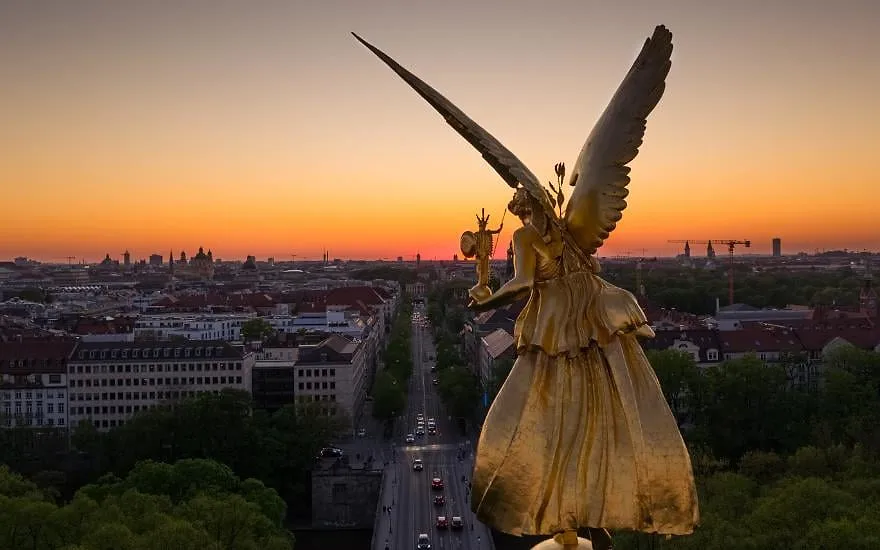
Where the Friedensengel stands
The monument rises on the eastern bank of the Isar, above the Luitpoldbrücke. Prinzregentenstraße leads west from the bridge into the city. From the upper terrace, the avenue forms the main line of the view.
The setting is part of the attraction. The golden figure is visible above the trees, while the terrace, steps and lower fountain connect the high bank with the road and river below. Walk between the levels if the stairs suit you, rather than viewing the monument only from a passing tram.
The Maximiliansanlagen extend along this side of the river. The monument therefore fits a longer park walk, with the Maximilianeum farther south and Bogenhausen streets behind the terrace.
Why Munich built the monument
Construction began in 1896 and the monument opened in 1899. The project marked 25 years of peace following the Franco-Prussian War of 1870–71. The title combines peace with a design drawing strongly on the classical language of victory.
Heinrich Düll, Georg Pezold and Max Heilmaier created the gilded bronze figure. The model was the ancient Nike of Paionios. Their collaborative role is more accurate than attributing the whole monument to one architect or a different sculptor.
The complete monument rises to about 38 metres. The figure itself is six metres high. From the lower fountain the height feels greater because of the terraced setting, but the column alone is not 38 metres with another six metres added above.
Reading the angel and the mosaics
The figure holds an olive branch in the right hand and a small Athena figure in the left. The olive branch supplies the familiar peace symbolism. The Athena figure and Nike model also connect the design with victory, wisdom and classical representations of public ideals.
At the base, four gold mosaics represent war, victory, peace and the benefits of culture. Look into the small temple-like structure rather than stopping at the outside columns. The mosaics add colour and detail far below the gilded figure overhead.
The water feature below includes figures riding dolphins. When the fountain is operating, the water and lower terrace make a useful place to pause before climbing the steps. Seasonal operation means a winter visit has a quieter appearance.
The monument is a public memorial from the late 19th century, so its imagery reflects the political and artistic language of the period. Reading the original purpose adds context to the more familiar modern use as a viewpoint.
The 1981 removal and restoration
The bronze figure was taken down in 1981 because of the danger of falling. Restoration followed, and the figure returned in 1983. The event was a precautionary removal and difficult repair, rather than the angel simply falling from the column.
The surface is gilded bronze. The gold appearance comes from gilding, rather than a later replacement by a solid gold alloy. Weather and maintenance have repeatedly shaped how the figure looks against the sky.
The terrace and the best light
In our experience, spring and early summer are the most appealing times, when the surrounding gardens are in bloom. The paths and terraces also work in other seasons, with fewer leaves revealing more of the structure and river setting.
Sunrise and sunset change the appearance of the gilded figure. Watch where the light falls on your chosen side rather than assuming one hour produces the same result year-round. The monument’s upper level and lower fountain also give quite different photographs.
For a broad view, step back across the river and look towards the monument. For the avenue view, aim for the terrace at Europaplatz. The column is not open for a spiral-stair climb, and the public viewpoint is at its base.
Keep clear of road traffic when taking photographs. There is no need for a boat trip or river access to get a useful view. The bridges, paths and public terrace provide enough variety for a short photography stop.
Getting there and access
The nearby stop is Friedensengel/Villa Stuck. Tram 17 is the published direct approach, with current services best checked through MVG. From the western bank, walk over the Luitpoldbrücke and follow the signed pedestrian route.
The site has changes in level, stairs and steep paths. The Palace Administration’s Maximiliansanlagen information and current access guide help with route planning. Aim for Europaplatz if your priority is the upper terrace, rather than assuming every river-level path gives step-free access.
Street parking in the wider area depends on local restrictions and available spaces. Public transport or a walk usually fits this visit better, especially if you intend to continue through the park afterwards.
Villa Stuck and Prinzregentenstraße
Villa Stuck lies nearby, with the former artist’s home and changing exhibitions. Check the museum’s current programme for opening and access before adding an indoor visit. The house and exhibitions have their own schedule, separate from the public monument.
Following Prinzregentenstraße west brings you towards the museums and the southern edge of the English Garden. Haus der Kunst and the Hofgarten area need a longer walk than the old seven-minute estimate to Odeonsplatz.
Cafés and restaurants lie in Bogenhausen and Lehel on opposite sides of the river. Choose according to the direction of your walk. Famous places such as Café Frischhut and Paulaner am Nockherberg are separate destinations, not immediate neighbours of the monument.
A longer walk by the Isar
The Maximiliansanlagen offer paths south towards the Maximilianeum. A longer route reaches the museums and riverside areas closer to the Deutsches Museum. Allow time for the distance rather than treating all east-bank sights as one small cluster.
The English Garden lies across the river and farther north and west. The Monopteros and Chinese Tower are possible destinations for an extended day outdoors. Families wanting a shorter stop are better served by the nearby park paths and terrace than a long list of distant attractions.
For swimming or any activity on the river, use the city’s designated-area information. The terrace visit itself needs no entry to the water. Our Isar guide helps place the different riverside sections in context.
Is the Angel of Peace worth visiting?
We think so, particularly if your plans take you east of the Isar. The combination of gilded sculpture, mosaics, fountain and avenue view gives a useful outdoor stop without a museum ticket.
Is there an interior viewing platform?
No public climb inside the column is offered. The terrace below the column is the viewpoint.