
The Munich Glockenspiel plays daily at 11 am and noon in the New Town Hall tower on Marienplatz, with another daytime show at 5 pm from March to October. The 9 pm show tells a different story. All shows are free to watch from the square.
We’ve seen the Glockenspiel many times. As the figures whirl into motion high up on the clock, it still feels like you’ve stepped back in time.
Updated
Quick Facts
| Quick fact | Details |
|---|---|
| Where | New Town Hall (Neues Rathaus), Marienplatz 8, 80331 Munich, Germany |
| Daytime shows | Daily at 11 am and noon. Also 5 pm from March to October. |
| Night show | 9 pm. The night watchman, an angel and the Münchner Kindl. |
| Tickets | Free to watch from the square |
| Nearest station | Marienplatz (U3, U6 and S-Bahn) |
| Good Friday | No shows. Good Friday falls on 26 March in 2027. |
Check the City of Munich’s Glockenspiel schedule if you’re making a special trip. Maintenance or events on the square sometimes affect show times.
Where to Stand for the Glockenspiel
Look for the crowd gathering below the tower a few minutes before the hour. I’d arrive about 15 minutes early if you want a clear view. The south side of Marienplatz faces the clock and gives you some distance from the building, so you’re less likely to spend the whole show craning your neck.
- If the front of the square fills up, step back towards the middle or the Mariensäule, the column with the golden figure at the top. Check you have both levels of the Glockenspiel in view.
- If you’re watching with children, leave enough room for them to see past the people in front. The figures are high up, so you don’t need to squeeze right under the tower.
- If you’d rather sit, ask for a table facing the New Town Hall at Café Glockenspiel.

What Happens in the Daytime Show?
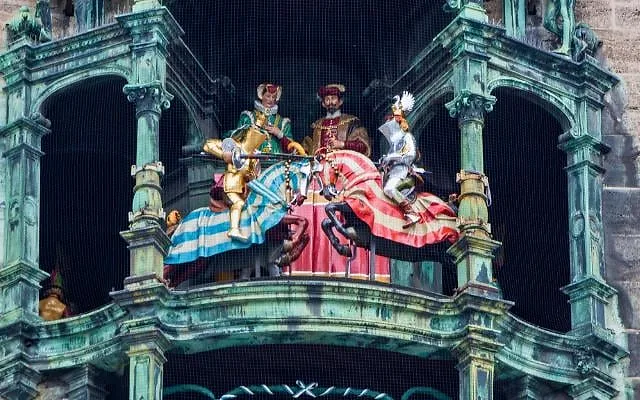
The figures stand well above street level, so taking a moment to identify the two balconies helps before the motion begins. The wedding party and tournament occupy the upper stage. The barrel makers dance below. They belong to separate stories rather than one continuous battle or celebration.
The Rathaus-Glockenspiel tells two stories on separate levels. Start with the knights on the upper balcony. Once the joust finishes, turn your attention to the dancers below.

The Wedding Joust on the Upper Level
The top scene takes you back to February 1568, when Wilhelm of Bavaria, later Duke Wilhelm V, married Renata of Lorraine. The celebrations ran for about two weeks and included fireworks, sleigh rides and a tournament on Marienplatz itself. The German Foundation for Monument Protection describes the celebrations and how they’re portrayed.
Watch what happens when the two knights meet. The Bavarian knocks the knight from Lorraine off his horse. There’s a buzz in the square when he goes down, and it’s the moment I’d tell children to watch for.
The Coopers’ Dance on the Lower Level
The lower figures perform the Schäfflertanz, or coopers’ dance. Coopers made wooden barrels. According to Munich tradition, they danced in the streets to coax people outdoors again after a plague epidemic. The story puts the dance in 1517, and the first written record dates to 1702. See the City of Munich’s historical timeline.
There’s a live version, too. Munich’s coopers last performed around the city from 6 January to 17 February 2026. Their regular season comes around every seven years, with the next due in 2033. See the city’s report on the live Schäfflertanz for photos and video.
Stick around when the dancers stop. A little rooster at the top flaps its wings and crows three times to finish the show.
What Happens at 9 pm?
At 9 pm the night watchman sounds his horn, and an angel blesses the Münchner Kindl, the child you’ll recognise from Munich’s coat of arms. The child is put to bed to music from Wagner and Brahms. The shorter night show is often quieter in the square. If you’ve come for the joust or the coopers, pick a daytime performance.
How the Glockenspiel Works
The Glockenspiel first rang in 1908. The figures are made of painted sheet copper, and there are 43 bells. Behind the scenes, a rotating cylinder studded with pins sets off the bell strikes in sequence. The tune changes with the month. Listen for “Loreley” in March or August and “O Tannenbaum” in December.
The mechanism now runs on solar power. During the 2007 restoration, the city cleaned and retuned the bells, which hadn’t been tuned in nearly a century. Munich residents helped pay for the work through donations. The City Hall guide has the restoration details and the full list of tunes.
The noon show and the seasonal 5 pm performance owe their place in the schedule to the 1972 Summer Olympics. Before the Games, 11 am was your chance to see the knights. Munich Tourism’s look behind the scenes.
How to Get to Marienplatz
Take the U3, U6 or S-Bahn to Marienplatz. From Munich Central Station (München Hauptbahnhof), it’s two stops on the central S-Bahn route via Karlsplatz (Stachus). On foot, allow about 15 to 20 minutes through the pedestrian centre.
When you come up from the station, look for the long Gothic façade on the north side of the square. The Old Town Hall at the east end is a separate building and houses the Munich Toy Museum. Open the Glockenspiel location in Google Maps.

What Else Is Nearby?
After the noon show, walk over to Viktualienmarkt for lunch. If you want a view across the Old Town rooftops, climb St Peter’s Church tower or take the short walk to the twin towers of the Frauenkirche. The Hofbräuhaus is nearby at Platzl if you’re heading out for a beer.
If you’ve got a thing for royal weddings and jousts, I’d make time for the daytime show. It’s one of the stops I’d keep on a one-day Munich itinerary, especially if you’re already exploring the Old Town. In Advent, the stalls are right below the tower. In 2026 the Marienplatz Christmas market runs from 20 November to 24 December, with a break on 22 November.
FAQs
How Long Does the Glockenspiel Play For?
Allow about 12 minutes for the daytime show. The length varies with the music. Give yourself a little longer if you’re arriving early for a good spot.
Does the Glockenspiel Go Off Every Hour?
The full show with the knights and dancers runs at the scheduled daytime performances. The tower clock’s ordinary chimes are separate.
Do I Need a Tower Ticket to Watch?
Watch for free from Marienplatz at street level. You only need a ticket if you’re visiting the New Town Hall’s viewing platform.
What Does Glockenspiel Mean in English?
Glockenspiel roughly means “play of bells”. In Munich, the name usually refers to the bells and moving figures together in the New Town Hall tower.