
When renting in Munich, compare the total monthly cost, check whether the address can be registered, and prepare your documents before you start applying. If you’re arriving without a flat, look at shared rooms or furnished short lets while you search. Before signing anything, find out what the rent covers and how much you’ll owe for the deposit.
Updated

We looked for flats in Munich before and during COVID. Even once I’d found a part of town I liked, getting to the viewing stage was a job in itself. I wasn’t joking in the old guide when I compared it to applying for work. You write a short introduction, wait, try again and get your paperwork ready for a decision that might come quite quickly. These are the parts of the search I’d spend time on if I were doing it again.
What rent should you budget for?
When comparing adverts, start with the Kaltmiete, the base rent. The Warmmiete adds the operating costs named in the agreement. Ask whether heating is included and whether you’ll need to pay separately for electricity or internet. Where you pay advances towards operating costs, the landlord accounts for them annually. Federal housing guide · Civil Code section 556
Munich’s 2025 rent index gives an average net cold rent of €15.38 per square metre per month. The sample covers qualifying leases and rent changes from February 2018 to January 2024. Use the city’s rent calculator to find the reference rent for a particular flat. Look separately at current listings to see what landlords are asking. Munich rent index
I used to look first at the price in big print. The figure you need for a budget is what goes out each month. Ask which charges are included, then add the expenses you’ll have to arrange. If two flats are close in price, check what’s there when you move in. A furnished short let and a longer lease in an empty flat aren’t directly comparable when one leaves you buying a kitchen or furniture.
Where do you look for a flat or room?
From experience, we recommend using ImmoScout24. ImmoScout24’s Munich listings are a starting point if you want your own flat. Look for Wohngemeinschaft or WG if you’d rather share. WG-Gesucht’s Munich room listings take you directly to rooms.
If you’re arranging a furnished place before you arrive, check the length of the let and whether the provider will issue the Wohnungsgeberbestätigung, the confirmation of move-in. A short let gives you time to view places. Factor the full cost and the move-out date into your search.
If I were trying to find a place from abroad, I’d start with a room in a WG or a furnished short let and use the first weeks to look around. A furnished place gives you a bit of breathing space and you can arrive with suitcases. Check the total cost, who you’ll live with and whether you can register before paying. I used ImmoScout24 for the wider search because private landlords and agents list there. A short German message mentioning which flat you’re replying to and when you could view it is more useful than a copy of your CV.
At the viewing, give yourself a few minutes to walk to the nearest stop rather than relying on the advert’s walking time. Ask what belongs to the landlord, whether anything needs buying from the outgoing tenant, and when the keys would be available. If the flat looks good, ask what they need next and when. I liked having those answers before deciding how far to take an application.
Where is best to live?
There’s of course no one single easy answer to this question, as it’s depended on your lifestyle, family and financial situation. Start with the commute. Check the journey from the actual address before deciding how much extra you’d pay for a neighbourhood. Our Munich transport guide explains the zones and ways to get around.
If your search is hard on your budget, the city’s rental support lists free tenancy advice, Munich Model housing, subsidised flats and housing benefit. Check eligibility for each programme before counting on it.
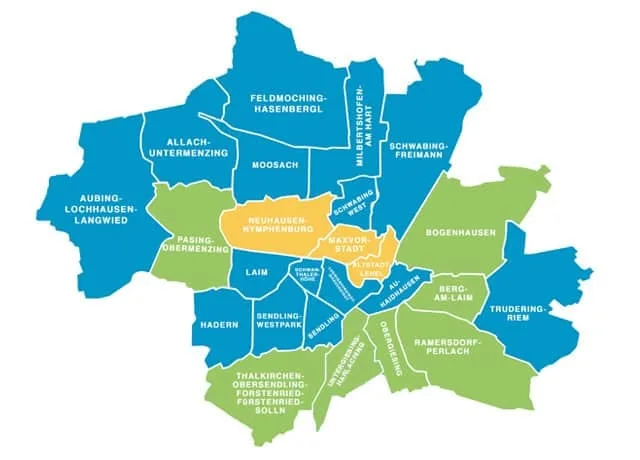
I made the old neighbourhood map because I was trying to compare where we’d spend our evenings with where we needed to be during the day. If cafés and a walk home matter, I’d look at Maxvorstadt or Schwabing first. If what you want at the end of the day is a park and somewhere to take children for a run around, I’d compare Neuhausen-Nymphenburg and parts of Giesing. This is a way to start looking, not a ranking. Two addresses in the same district can mean different journeys. Munich’s district directory
Check the walk from the door to the stop, the last stretch after dark and whether you’d be changing trains every morning. When the search got tiring, I found it easier to keep two or three areas in mind than to say yes to every viewing anywhere in Munich. If you’re moving with someone else, check both commutes before you start comparing rents.
What documents do you need for an application?
Prepare a short introduction, proof of income, ID and any documents you expect to need. If you’re newly employed and have no payslips yet, ask whether an employment contract or a letter from your employer will do. A landlord might ask for a tenant self-disclosure form or evidence of creditworthiness later in the process. Federal housing application guidance
Send only the information needed at each stage. A message asking to view a flat is different from an application for a place you want to rent. Germany’s privacy regulators explain what landlords should ask for at a viewing, during the application and when a tenant has been selected. The city’s newcomer guide advises against sending a passport early or paying to see a property. Rental applicant privacy guidance · Munich newcomer housing guide
One word you’ll see is Schufa, the name often used for a credit check. Ask which evidence the landlord needs and at what stage. When you’re new to Germany you might not have a local record yet. A work contract or employer’s letter is something to discuss once the application has reached that stage. I used to think of the paperwork as the job-application part. Keep the introduction personal, but you don’t need to attach a profile photo, full bank statements or an ID scan to every viewing enquiry. Use the privacy guidance above to decide what to share.
What do you check before signing?
- Compare the base rent, operating costs, heating and any separate charges. Check whether the lease sets future increases.
- Check what comes with the flat. If you saw a fitted kitchen or other furniture at the viewing, make sure the agreement says who owns it and what stays.
- For an ordinary residential lease, the deposit is capped at three months of base rent, excluding separately stated operating costs. If the deposit is cash, you’re entitled to pay in three equal monthly instalments. The first is due at the start of the tenancy.
Check who you’re dealing with before paying. A demand to send money in exchange for a viewing or for keys you have yet to see is a reason to stop and verify the offer. Deposit law, Civil Code section 551 · Munich tenancy advice
What happens when you move in?
Record the condition of the flat at handover and ask for the landlord’s confirmation of move-in. If you’re moving to Munich to live here, the city’s usual registration deadline is 14 days after moving in. Eligible main-residence registrations have an online option. Use the city’s checklist for documents and exceptions, or follow our Munich address registration guide. Munich residence registration
If you need to furnish the flat, our Munich second-hand shops guide has places to start.
At handover, I’d go around the rooms with the landlord and make a note of scratches, missing items and anything that needs fixing. Record the meter readings if there are separate meters and count the keys. Write it down while you’re both there, rather than trying to reconstruct it once you’ve unpacked.
What has changed in 2026?
On 16 October 2026, Munich’s social affairs committee approved a rent monitoring project. The city plans to compare online listings with its reference rents and contact landlords about potentially excessive asks. If you want help with an individual contract, the city’s tenancy advice service is the route to use. City announcement · City tenancy advice